 |
| Image Found Here |
It's been a while since I've blogged. I started a new position, followed by another new position, which means a lot of learning these positions and not a lot of blogging. But I'm back. In part because I read an awful children's book with a student I tutor, and I needed to share.
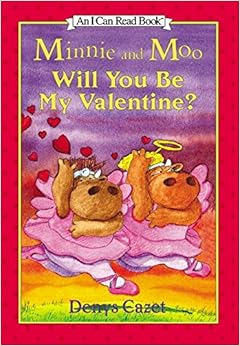
It's February, which means Valentine's Day. I was feeling particularly festive and picked up Denys Cazet's Minnie and Moo Will You be My Valentine? The gist is that two cows decide to get into the spirit of the holiday. They write quite a few love poems and then (dressed as cupids) shoot them off attached to arrows.
That's a cute premise, right? Who doesn't want to spread love? Who doesn't want to see cows dressed as cupids? What could possibly go wrong?
First page:
Minnie and Moo sat under the old oak tree. (Cazet 5)Okay, so far so good.
A box of cream puffs sat on Minnie's lap. (Cazet 5)Not my go-to snack, but to each their own.
"Since I'm on a diet," she said. "I'll start with the smallest." (Cazet 5)Wait, WHAT? I get the joke: cows are big (in fact, being called a "cow" is an insult insinuating that you're overweight). But why is it at all necessary to imply that this female cow needs to be on a diet? To remind readers that women stereotypically go on diets? To get it into a young reader's mind that she (or he) might want to go on a diet or monitor their cream puff intake?
It gets better.
Two other cows receive a poem from Minnie and Moo. (Remember, Minnie is the one concerned about her weight.) It reads:
Dearest buffalo lips,
Your ultra-wide hips
are as big as six ships. (Cazet 23)It's unclear whether this poem was meant to be given to the cows. In the next scene, Minnie whispers to Moo to "make sure it's the right poem [this time]" (Cazet 25). So, the reader might assume the poem was meant for someone else, but who? And does that make it much better? It's not like the poem was celebrating curvy figures. Few people/anthropomorphized animals want to be referred to as "big as six ships." It's not exactly a complimentary simile.
Then to top it all off, the turkeys cry out "INDIANS!" (Cazet 35) when an arrow comes there way. Because we haven't had enough stereotypes in this book.
I hope you, dear readers, had a wonderful Valentine's Day (and week that followed). May your Valentine's books be free of stereotypes and full of chocolate.
